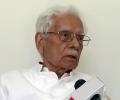
Because of his proximity to Indira Gandhi, he was able to intervene directly at the level of the PMO, which he did in the days leading up to the partition of Pakistan in 1971 when he transferred crucial information about Pakistan's moves via information handed to him by an East Pakistani diplomat in Poland where he was posted.

'The Paris Olympics has once again blessed the Indian sports marketing landscape with fresh faces and promises.' 'Expect at least one biopic.'

Mutual Fund inflows in FY25 have already reached two-thirds of the total inflows seen in the entire FY24, with net inflows standing at Rs 1.3 trillion.

Lawyers flooded the courtroom of Chief Justice of India D Y Chandrachud to witness the proceedings as one special guest -- Aamir Khan -- was seated in the front row.

Out of 3,871 recovery certificates issued by the regulator in various cases, 807 have been certified as difficult to recover.
Consumers are unlikely to disconnect their mobile connections and will most likely absorb the up to 22 per cent tariff hike imposed last week by Jio, Airtel, and Vodafone Idea (Vi), according to analysts. The last major tariff hike in 2021 was followed by a 4-5 per cent SIM consolidation, with people leaving mobile operators with more expensive plans for their peers offering comparatively affordable options.

Messages sent through Internet-based messaging service providers such as Whatsapp, Signal, and Telegram, as well as those which are encrypted, are understood to be within the Act's ambit.

'The idea is to frame the ToR quickly, so that Trai can begin its consultations with industry stakeholders.'

Many who track the ministry and the technology sector closely believe that the space won't see much impact on the policymaking side, but the gestation time for regulations might get long, as now there could be a wider consensus-building exercise on policy matters under a coalition government.

Rising energy demand could tilt India's energy basket towards fossil fuels from coal to oil, natural gas.

Numbers could be classified further into (140) marketing and (160 or 161) for service calls to easily identify the purpose of the call in the future.

'China is India's primary strategic challenge, which will not go away.

Telecom service providers have doubled down on their demands for a proposed fair-share charge (FSC) to be levied on major over-the-top (OTT) service providers, opening up the 6 GHz spectrum band and increasing the number of testing labs for telecommunication products. Telecom industry body Cellular Operators Association of India (COAI) on Wednesday said these were the topmost demands for Prime Minister Narendra Modi-led National Democratic Alliance (NDA) government. The industry body wants this additional capital expenditure to be borne by these Large Traffic Generator (LTGs) OTTs as a proposed fair-share charge.

BPCL is a high revenue-earning public-sector undertaking (PSU) and plans to privatise it are completely off the table, Petroleum and Natural Gas Minister Hardeep Singh Puri said on Tuesday after assuming charge of the ministry for the second time. "Why would we divest ourselves of highly successful Maharatnas like BPCL," Puri said, arguing the Centre was not in favour of divesting its stake in oil PSUs.

'In the new coalition government, India's reform agenda may prioritise job creation and factor market reforms.'

Bharti Airtel may end up cumulatively bidding for more spectrum than market leader Reliance Jio in the upcoming auctions. This is owing to its need for spectrum renewal, and a requirement for 900 MHz in a few circles, analysts have said. Despite the muted bidding expected in the upcoming auctions, Airtel may end up making more bids than Jio, they added.

Launched in March, it triggers re-verification of suspected fraudulent numbers. Failing re-verification, the number will be disconnected.

Vodafone Idea's (Vi's) subscriber loss reduced to a seven-month low in March, and alongside the company added 1.1 million broadband users after two months of net loss -- two things analysts have noted as key trends that need to be monitored. While Vi has been losing customers for more than two and a half years now, the churn reduced to below a million after five straight months in March, the Telecom Regulatory Authority of India (Trai) data has shown. "Jio's softer than usual subscriber growth in March, and VIL's slowing subscriber market share loss are key trends to keep an eye on going forward," global investment banking and financial services major UBS said in an analyst note.


The latest flashpoint in West Asia has derailed India's preliminary plans to resume crude oil imports from Iran, officials said. In January, officials of the Ministry of Petroleum and Natural Gas had told Business Standard that the government had been studying proposals for the same, given that India was trying to expand sources of imports. "We are always monitoring the situation when it comes to crude flows.
